Comparison and decision guides
Heat Pump vs Furnace: Which Fits a Missouri Home?
In a Missouri home, a heat pump vs furnace choice depends on your existing ductwork, fuel costs and how much backup heat you want. A heat pump handles most St. Louis winters. A gas furnace still wins on the coldest nights, and many homes pair the two.
Published October 30, 2026 · Updated October 30, 2026 · By Kenan Perkins, Owner
- 4.6★ on Google29 reviews
- A+ BBB ratingNot BBB accredited
- Founded in 2010Repair-first advice
- Open 24 hoursCall any time
A heat pump fits most Missouri homes that need new cooling anyway. A gas furnace fits homes with sound gas service and a need for strong heat on the coldest nights. Many households end up with both: a heat pump for most of the year and a furnace as backup.
How does a heat pump compare with a furnace in St. Louis?
A furnace makes heat by burning gas. A heat pump moves heat, and it can run backward in summer to cool the house. The Department of Energy says modern air-source heat pumps can reduce electricity use by 50% compared with furnaces and baseboard heaters. ENERGY STAR says certified units can deliver up to three times more heat energy than the electricity they consume.
| Factor | Heat pump | Gas furnace |
|---|---|---|
| Energy source | Electric (Ameren) | Natural gas (Spire) |
| Cooling | Yes, in the same equipment | Needs a separate AC |
| Cold-night output | Drops as temperatures fall; backup heat helps | Steady regardless of outdoor temperature |
| Combustion | None | Needs venting and annual safety checks |
| Defrost | Yes, in cold, damp weather | No |
| Typical pairing | Electric strips or a furnace as backup | Matching AC |
Want a technician to take a look?
Call and tell us what the system is doing. You will get a clear, upfront quote before work starts.
- 4.6★ on Google29 reviews
- A+ BBB ratingNot BBB accredited
- Founded in 2010Repair-first advice
- Open 24 hoursCall any time
Do heat pumps work in Missouri winters?
Yes, with the right model and sizing. St. Louis is in ASHRAE Climate Zone 4A, mixed-humid, with 4,100 heating degree days in 2025 against a normal of 4,433, according to the National Weather Service. That is cold enough that backup heat belongs in the plan and mild enough that a heat pump carries most of the season.
ENERGY STAR cold climate heat pumps are tested down to 5°F and keep running below that, though ENERGY STAR notes pairing one with backup heat is most efficient at the lowest temperatures. If you want one, ask the contractor for the capacity at 5°F, not only the SEER2 rating.
Which costs less to run?
It depends on your rates, and nobody can answer it honestly without your bills. Spire's gas price and Ameren's electric price move independently. Ask for a written operating cost estimate that states the rates it assumes, and compare against your last twelve months of both bills.
Two details change the result. Heat pumps do not save by deep setbacks, so ENERGY STAR advises a steady setpoint. And a duct system that leaks 20-30% of its air, a figure ENERGY STAR cites for typical systems, wastes a heat pump's efficiency as much as a furnace's.
A break-even check you can run with your own bills
A heat pump costs less to run than a gas furnace when its efficiency beats a break-even number. One therm of gas holds about 29.3 kWh of heat, so the break-even COP (heat delivered per unit of electricity) is the electric price per kWh, times the furnace AFUE, times 29.3, divided by the gas price per therm.
The rates below are hypothetical placeholders at $0.12 per kWh, not Ameren or Spire prices:
| Gas price per therm | 80 AFUE furnace | 96 AFUE furnace |
|---|---|---|
| $1.00 | heat pump needs COP above 2.8 | above 3.4 |
| $1.50 | above 1.9 | above 2.3 |
| $2.00 | above 1.4 | above 1.7 |
The catch is that COP is not one number. It falls as outdoor temperature drops, so a heat pump can be the cheaper heat source in a 40°F November and the dearer one on a 10°F night. That is why dual fuel exists, and why the next point matters.

What is the balance point, and who sets it?
The balance point is the outdoor temperature where the heat pump's output equals what the house loses. Below it, the home needs backup heat. In a dual fuel system the thermostat or control switches to the furnace at a chosen outdoor temperature. In an all-electric system, electric strips take over, and they cost more per unit of heat than the heat pump does.
Set it by the numbers above, not by habit. A lower switchover favors the heat pump in mild weather. A higher one protects against the cold-night efficiency drop, and costs you the heat pump's savings. Ask any installer what switchover temperature they would set and why.
What does each cost to install?
Costs are attributed here because we do not publish a price for either. Homeyou reports a heat pump installation in the St. Louis area averaging $5,300 to $6,971 across 332 projects in 2025. Angi reports full HVAC replacement in St. Louis at $4,755 to $11,888 in 2026, averaging $7,133. Our furnace replacement cost guide breaks down what moves a furnace price.
Ductwork, electrical capacity, a gas line and access drive the spread. A heat pump on a 100-amp panel, or ducts sized for an old furnace, can add work that does not appear in the first number you hear.
What rebates apply in 2026?
Ameren Missouri's 2026 chart, valid January 1 to December 31, 2026, runs HVAC rebates through tier 4 of Pay As You Save (PAYS). It lists $2,000 per system for air-source heat pumps at 15.2+ SEER2 in dual fuel, electric-resistance replacement and no-existing-central-system cases. Mini splits at 19+ SEER2 get $500 per ton.
Work must go through a participating contractor, who submits the paperwork. We do not claim to be one, so confirm any rebate in writing before signing, because a 2027 chart may differ. Federal 25C does not apply to equipment placed in service after December 31, 2025, per the IRS. Missouri's HEAR and HOMES programs had no confirmed launch as of mid-2026, so check Missouri DNR's energy page.
Which setup fits which house?
| Your house today | Setup to price first | Honest caution |
|---|---|---|
| Sound furnace under 15 years old, AC near the end | Heat pump added to the furnace (dual fuel) | Keep the furnace only if it passes a safety check |
| Old furnace and old AC, ducts in good shape | Furnace and AC swap, versus heat pump plus furnace | Price both before deciding |
| Electric resistance heat, no gas | Heat pump | Check panel capacity first |
| Boiler and radiators, no ducts | Neither of these | A ductless system or boiler repair fits better |
| Leaky or undersized ducts | Fix the ducts first | New equipment will not reach its rating |
What does heat pump air feel like?
It feels milder. Energy Vanguard cites supply air of about 100°F in heating mode, and a gas furnace typically delivers hotter air. The house still reaches the setpoint, but the vent air feels less like a blast. People who expect furnace-style air often think something is wrong. Tell them in advance, and give the system time to run at a steady setpoint.
From the field: options beat a one-size answer
One Google reviewer, Candice F., described Kenan as great at explaining things and giving you options. That is the right standard for this decision, because the honest answer changes house by house. A heat pump replacing a failing AC in a home with a good furnace is a different job from replacing both.
The founder started the company because he disliked sales pressure, and the stance carries here. A furnace that is still sound and under 15 years old does not need to come out because heat pumps are fashionable. The sizing step is where good and bad proposals separate.
Which fits a postwar home in Jennings or Ferguson?
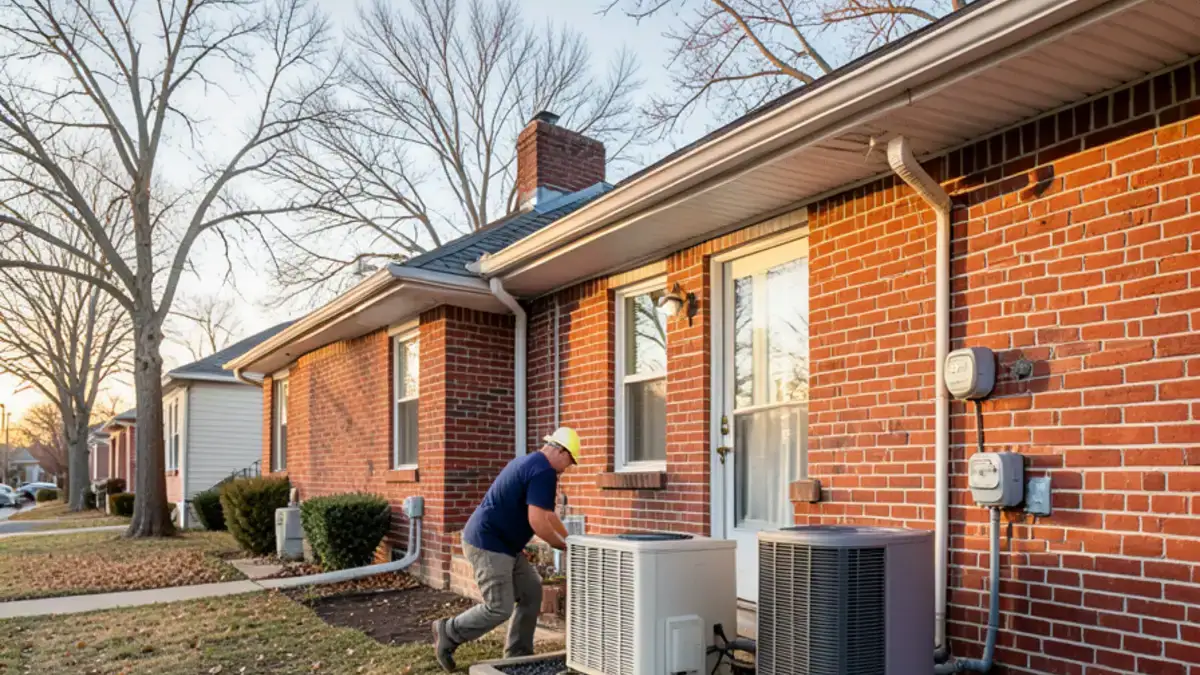
Postwar brick houses around Jennings and Ferguson often have a furnace in a basement or closet, a single-zone duct system and an AC that is nearing the end of its range. For those homes, a dual fuel replacement is often worth pricing against a like-for-like swap. Walk through it with a load calculation first, since ENERGY STAR says a Manual J calculation should size the system.

What to gather before you ask for a quote
Gather your last twelve months of Ameren and Spire bills, your furnace and AC ages, and the panel size. Then call for a quote. Our heat pump installation and furnace installation pages explain how we approach each, and you get a clear, upfront quote before any work begins. We are open 24 hours.
About the author
Kenan Perkins
Owner of Kenan Corporation. Studied at Ranken Technical College. The company, founded in 2010, is built on repairing systems honestly rather than pressuring people into new ones. More about us.
Sources
- U.S. Department of Energy, Pump Up Your Savings with Heat Pumps
- ENERGY STAR, Air-Source Heat Pumps
- ENERGY STAR, Duct Sealing
- Ameren Missouri, HVAC rebates and PAYS (2026 chart)
- Angi, HVAC replacement cost in St. Louis (2026)
- Homeyou, heat pump costs in Saint Louis (2025)
- IRS, FAQs on One Big Beautiful Bill changes to 25C and other credits
- Missouri Department of Natural Resources, energy
- Energy Vanguard, What Happens to the Frost on My Heat Pump?
- National Weather Service St. Louis, climate data
- U.S. Department of Energy, central air conditioner regional standards guidance
Heat Pump vs Furnace in Missouri: common questions
Do heat pumps work in Missouri winters?
Yes. St. Louis sits in ASHRAE Climate Zone 4A, and ENERGY STAR cold climate heat pumps are tested down to 5°F. Units keep working below that, but ENERGY STAR says pairing one with backup heat is most efficient at lower temperatures. Ask for the model's low-temperature capacity, not just its efficiency rating.
Is a heat pump cheaper to run than a gas furnace?
It depends on your electric and gas rates, so get a written operating cost estimate. The Department of Energy says modern air-source heat pumps can cut electricity use by about 50% against furnaces and baseboard heaters. That compares electric heat, not Spire's gas rates against Ameren's.
What is a dual fuel system?
A dual fuel system pairs a heat pump with a gas furnace. The heat pump handles mild weather, and the furnace takes over below a set outdoor temperature. ENERGY STAR describes the setup as a heat pump alongside an existing furnace, and Ameren's 2026 chart lists dual fuel among eligible cases.
Can I still get a federal tax credit for a heat pump?
Not under 25C for equipment placed in service after December 31, 2025, per the IRS. Do not budget for it. Check Ameren's current chart and Missouri DNR's energy page for state programs, and get any rebate terms in writing before you sign.
Talk to an HVAC specialist
Tell us what your system is doing and where you are. Open 24 hours.
Kenan Corporation, 927 Broadhead Lane, St. Louis, MO 63138. Open 24 hours.
- 4.6★ on Google29 reviews
- A+ BBB ratingNot BBB accredited
- Founded in 2010Repair-first advice
- Open 24 hoursCall any time